| ROADAR | This project is closed |
| Road Origin and Direction Attained by Radar |
|
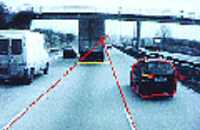
Context A knowledge of the road geometry ahead of a vehicle is necessary for future automotive safety systems and to allow progress towards systems which allow a degree of automation of the driving task Existing system require the installation of markers in the carriageway and are therefore likely to take many years to implement Rear-end collisions account for 80% of accidents on all roads. Aims To assess the feasibility of detecting road geometry by analysis of a radar image using techniques such as those developed for machine vision. This must include a description of the road edges up to 200m ahead, the position of exit and entry ramps. To investigate ways of rejecting radar returns from objects such as bridges and road furniture from an analysis of their radar signatures To investigate ways of enhancing the radar signatures of these objects so as to identify their presence uniquely To implement the algorithms in hardware on a demonstrator vehicle to allow evaluation on public roads and a quantified comparison between alternative path prediction methods Method Equip a vehicle with a scanning microwave radar and data recorders for the acquisition of representative synchronised radar and video data Characterise the phenomena contributing to the observed radar images including the positive and negative aspects caused by reflections Investigate the possibility of recognising the signatures of objects such as road edges, bridges, overhead gantries and other vehicles Explore the possibility of fusion of the radar data with that from other sensors, and of the creation of a 3-d image of the road scene Develop and implement algorithms to predict the path of the road Compare the results of the road trajectory estimation with those obtained by alternative methods such as yaw rate measurement, video and map-matching Benefits An increase in the safety of road transport. Significant benefits to drivers with impaired vision or reaction times and for all drivers in adverse weather conditions A reduction of the congestion resulting from rear-end collisions and lane departure Participants Jaguar Cars Ltd University of Birmingham Cranfield University |
|
|
|
|
|
|
|
|